

If you’ve searched for PC sheet machines, you might be looking for industrial equipment rather than a computer component. In this context, “PC” stands for Polycarbonate, a remarkably durable and versatile thermoplastic. A PC sheet machine is the specialized industrial extrusion equipment used to manufacture continuous, flat panels or sheets of polycarbonate plastic. These clear or tinted sheets are famous for their strength, light transmission, and applications everywhere from greenhouse roofing to bullet-resistant windows.
This article will explain what these machines are, break down how they work, and explore the material that makes it all possible.

Understanding Polycarbonate (PC): The "Star" of the Show
Before diving into the machine, it's crucial to understand the material it processes. Polycarbonate is an engineering-grade polymer known for:
Extreme Impact Resistance: It is virtually unbreakable, offering up to 250 times the strength of standard glass.
High Light Transmission: It allows over 90% of light to pass through, similar to glass.
Lightweight: It is about half the weight of glass.
Thermal & UV Resistance: Properly coated sheets can withstand harsh weather and UV radiation without significant yellowing or degradation.
Flexibility: It can be thermoformed or cold-bent to a degree.
These properties make PC sheets ideal for construction (skylights, canopies), agriculture (greenhouses), advertising (signage), automotive (headlamp covers), and protective glazing.
What is a PC Sheet Machine?
A PC sheet machine, more accurately called a polycarbonate sheet extrusion line, is not a single machine but a complete, integrated production system. It is designed to continuously melt, form, cool, and finish polycarbonate resin into sheets of precise thickness, width, and optical quality.
The core of this system is the extruder. Raw polycarbonate resin in pellet form is fed into the extruder, where it is heated, melted, and homogenized under controlled conditions. The molten plastic is then forced through a critical component called a flat sheet die, which shapes it into a wide, continuous curtain of precise thickness.
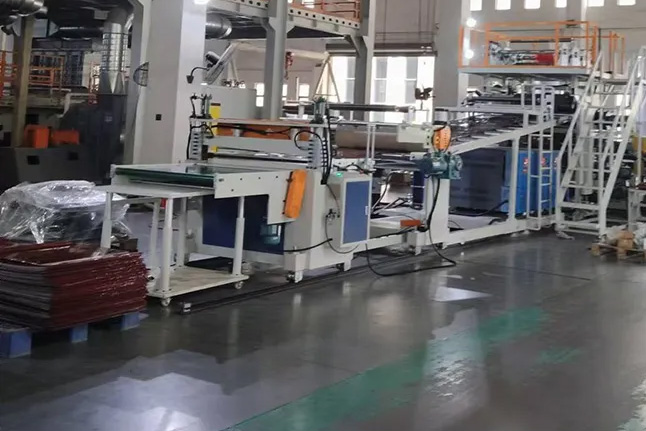
How Does a PC Sheet Machine Work? The Step-by-Step Process
A typical PC sheet extrusion line operates in a continuous, synchronized flow. Here’s a breakdown of the key stages:
Stage 1: Feeding and Drying
Polycarbonate resin is highly sensitive to moisture. Before entering the extruder, the PC pellets must be thoroughly dried in a hopper dryer to remove any trace moisture. Even tiny amounts of water can cause hydrolysis during melting, degrading the polymer and creating defects like bubbles or streaks in the final sheet.
Stage 2: Melting and Extrusion
The dried pellets are fed into the extruder barrel. A rotating screw inside the barrel transports the material forward. As it moves, it is heated by external electric heaters and the internal friction (shear) generated by the screw. The PC gradually melts into a uniform, viscous fluid. The design of the screw—its compression ratio, mixing zones, and length-to-diameter (L/D) ratio—is critical for achieving a perfectly homogeneous melt without overheating, which could degrade the polycarbonate.
Stage 3: Forming the Sheet
The molten polycarbonate is then pumped under high pressure through a flat sheet die. This precision-engineered metal block has a wide, slit-shaped opening (often over 2 meters wide) that determines the final width and initial thickness profile of the sheet. The die lips are usually adjustable (with choker bars or flex-lip systems) to fine-tune the thickness across the entire width of the sheet.
Stage 4: Polishing and Calendering
As the hot, soft plastic curtain exits the die, it immediately enters the most critical part of the line: the polishing stack or calendar. This consists of a series of highly polished, chrome-plated steel rollers. Typically, a three-roll stack is used. The molten sheet passes through the nip (gap) between the first two rolls, which precisely calibrates its thickness and imparts a smooth surface. It then wraps around the second and third rolls for further cooling and surface finishing. The temperature and speed of these rolls are meticulously controlled to achieve the desired sheet clarity (glossy or matte finish) and dimensional accuracy.
Stage 5: Cooling and Conveying
After the polishing stack, the now-solidifying sheet travels across a long conveyor system through multiple cooling zones. This section often includes additional supporting rollers and temperature-controlled air knives or chambers to ensure the sheet cools evenly and flat, preventing warping or internal stress.
Stage 6: Trimming and Winding/Cutting
The edges of the sheet (where thickness may be inconsistent) are trimmed off using edge trimmers. The trim material is recycled back into the extruder. Finally, for thin-gauge sheets, the continuous sheet is wound into large rolls using a winder. For thick, rigid sheets (like multi-wall polycarbonate or solid sheets over 3mm), the line is equipped with a stationary cutter or saw that automatically cuts the sheet into predetermined lengths, which are then stacked.

Key Components for Quality
Co-extrusion Capability: Many modern lines have a second, smaller extruder to co-extrude a thin, protective UV layer directly onto the sheet surface during formation. This layer is essential for outdoor applications.
Computerized Controls: The entire process is managed by a sophisticated PLC (Programmable Logic Controller) that monitors and adjusts temperatures, screw speed, roller speeds, and puller tension to maintain consistent quality.
Online Thickness Gauge: A scanning gauge constantly measures the sheet thickness across its width and provides feedback to automatically adjust the die lips for perfect uniformity.
